

VISIT THE ANCIENT GREEK MONUMENTS
If you’re visiting Athens for the first time, the Acropolis experience is not to be missed. Located in the centre of the city, the whole site is named after the beloved Virgin Goddess Athena, the city’s patron deity and the Goddess of War, Peace, Wisdom, Justice and Crafts.
I had dreamt of visiting the Acropolis in Athens for a long time and I finally realised that dream recently. What an enthralling experience and definitely a highlight of Europe. The Acropolis is one of the most awe-inspiring destinations and breathtaking sites in the world for anyone with a love of history, architecture, ancient ruins, archaeology, art, Greek Gods or Mythology.
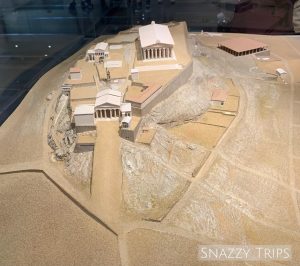
The Acropolis sits majestically high up on the hill overlooking the whole city, a tribute to the heritage and endurance of the people of Athens. There is a law that states no buildings in Athens are allowed to block sight of the sacred Acropolis. The people must have direct vision of the Acropolis from almost anywhere in the city.
What is at the Acropolis?
The Acropolis as it stands today, is a collection of magnificent ancient structures built in the style of Classic Greek Architecture:
- The Parthenon
- The Erechtheion
- The Propylaea and
- The Temple of Athena Nike.
During the Golden Age of Ancient Greece (460 to 430 BCE), the period of power and wealth, the Athenian Ruler Pericles, ordered the construction of these major buildings of the Acropolis. They took approximately 50 years to complete, a true marvel for that time in history, given the location and the lack of modern construction equipment. Many skilled artisans, citizens, foreigners and slaves worked on the site.
There were also several other monuments and temples built at the Acropolis that have not survived the many natural disasters, wars and human intervention over time. One of these was an enormous bronze statue of the Goddess Athena herself, and a statue of Agrippa of Athens.
A Symbol of Greece
This architectural complex is the symbol of Greece and pride of the country, epitomising the strength and glorious past of Ancient Greece in the Golden Age. A cultural, religious and historic landmark that attracts millions of visitors yearly, making it one of the most visited tourist attractions in the world.
The word ‘acropolis’ simply means a high city of ancient Greece and refers to the whole hill. It served as residence of the ruler, a place of refuge and worship for the people. The reason it was built up there on a rocky outcrop was so that it could be more easily defended, be seen by the people, be closer to the Gods, and the slopes of the hill had natural springs.
Tours
The best way to enjoy the Acropolis Experience is to take a guided tour of the Acropolis and the modern Acropolis Museum so as you can explore the full archaeological site with the knowledge and commentary of a local expert as you go. They will enthral you with the many tales and legends of historical and mythical Greece, and take you to the best photographic angles of the iconic monuments.
I chose a tour with a terrific local guide, an expert in the field of ancient Greece, who guided us up to the top, through the gates, around the whole site and regaled us with stories and facts of the history and events that have shaped the Acropolis of Athens.
Prior to the visit we were taken to the new and fabulous Acropolis Museum across the road. This is a must visit and must be done together to fully appreciate the Acropolis experience. You can do them in either order.
The Museum houses all the artefacts, friezes, statues, ornaments and more that has been salvaged from the Acropolis site and keeps them protected, for us to be able to appreciate for years to come.
I definitely suggest taking a combined tour of the two attractions, which covers several hours at least, and hopefully you will have some free time to roam around on your own as well.
Parthenon
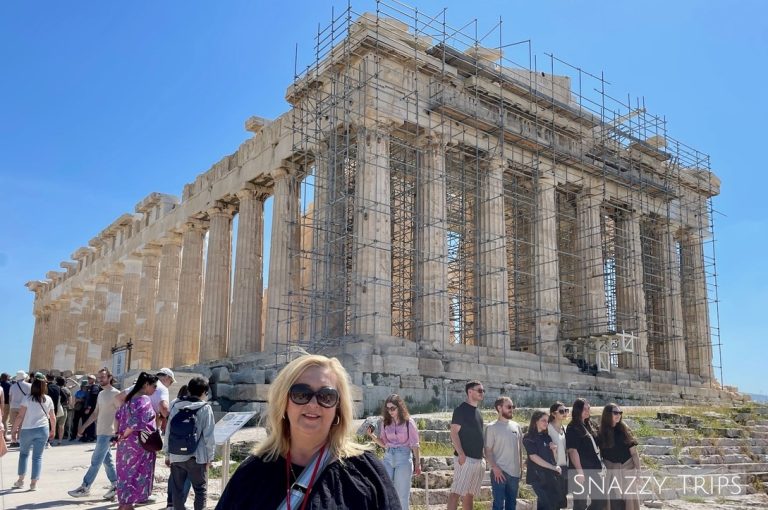
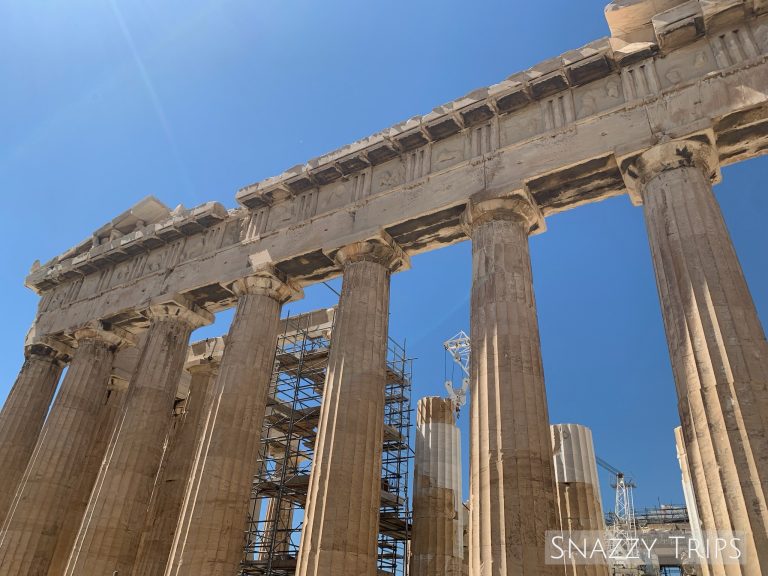
The Parthenon, not to be confused with the Pantheon in Rome, is the imposing, rectangular temple with Doric columns all the way around it, that stands out proudly above all the other monuments in the Acropolis. It measures 69.5 x 30.9 metres.
Built to honour the pagan Goddess Athena, the building was completed in 447 BCE, after only nine years of works. Parthenos means virgin, hence the Virgin Goddess Athena namesake. An enormous ivory statue of Athena was housed inside the temple.
The Parthenon was decorated with intricate sculptures representing the Greek Gods and mythology, and illustrating battles and celebrations of the Athenian people.
Interestingly, it also served as a treasury, and later was converted to a church by the Christians, and a mosque by the Turks.
Over the centuries it has been damaged severely by wars, looting and other disasters, including various earthquakes.
The horizontal marble steps, the iron and lead joints, and the columns made in pieces rather than whole monoliths, all give the Parthenon triple protection from earthquakes. The building will move in the event of tremors but not collapse, hopefully!
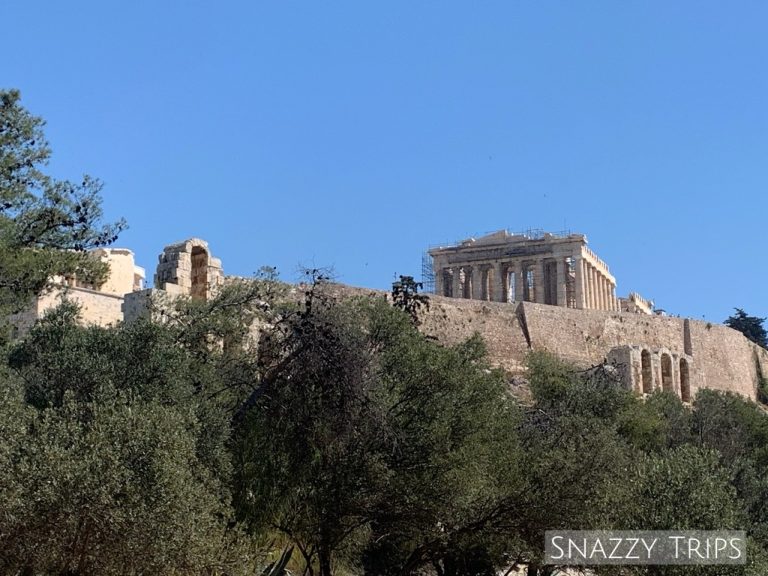
This most famous building of the Acropolis is truly a masterpiece of ancient Greek architecture and engineering. All the pieces are unique and much of it has been taken apart and re-assembled over the years. Scaffolding has now become a semi-permanent feature on this much loved iconic ancient Greek monument, as the Greek Government continues to strive to reverse some of the damage done in the past, conserve the remaining ruins, and for further archaeological research.
The Parthenon, considered to be the best example of Greek architecture, is the big attraction here, the pièce de résistance, and the main reason people visit the sacred hill, often forgoing the other monuments entirely.
Arguably, the most important building in the country, the Parthenon is extremely important to Greek culture, both in Ancient Greek times and in Modern Greece.
Erechtheion
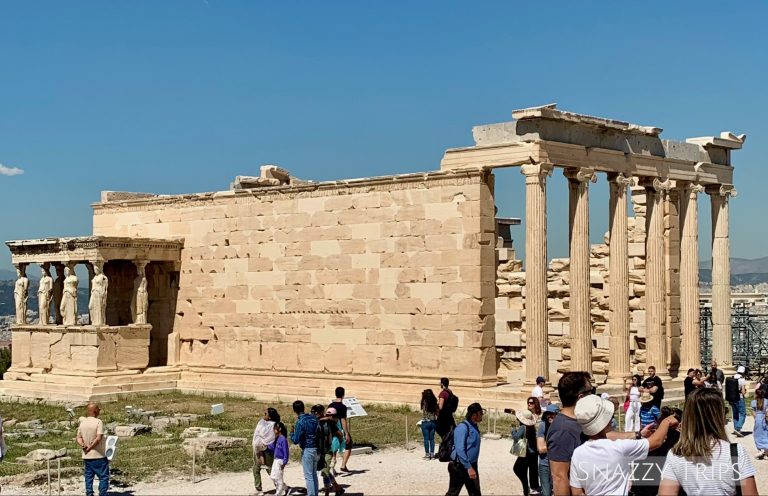
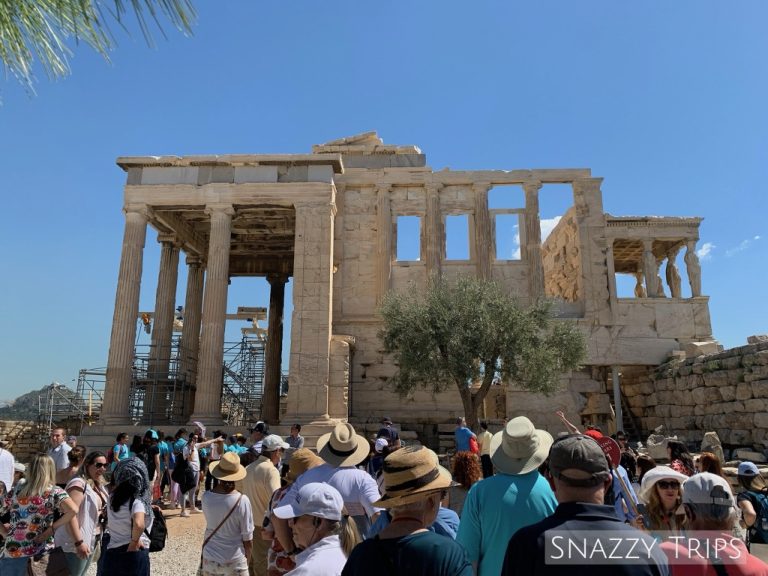
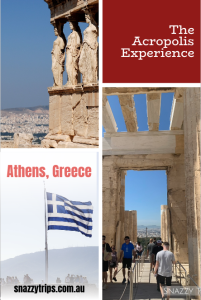
The Erechtheion with the famous porch of the maidens, was built to honour the Greek god Erechtheus, who was a King of Athens in Greek Mythology. The temple is adorned with six Caryatids, statues of robed ladies serving as columns, supporting the porch roof, rather than the usual columns. Each one of the ladies are 2.1 metres tall and are standing in a dynamic pose with weight more on one leg, called a contrapposto position in ancient Greek sculptures. The necks of the ladies had to be made slightly larger than would be normal, to make the columns stronger.
This is one of the most unusual, yet beautiful ancient monuments you will see.
Built from 421 BCE in memory of the dispute between the Goddess Athena and the God Poseidon about which of them deserved to be the patron of the city, according to ancient legend. However the name Erechtheus was the name of the King of Athens.
All the existing cults of various Gods in the area below the Acropolis were brought together here to worship in one place.
Later in its lifetime, it was converted into a church, a palace and even a residence.
The original six Caryatid statues have been removed from the site to protect them from damage and weathering and are all housed in the Athens Acropolis Museum, except one which is in possession of England. Greece is seeking the return of the important statue.
Propylaea
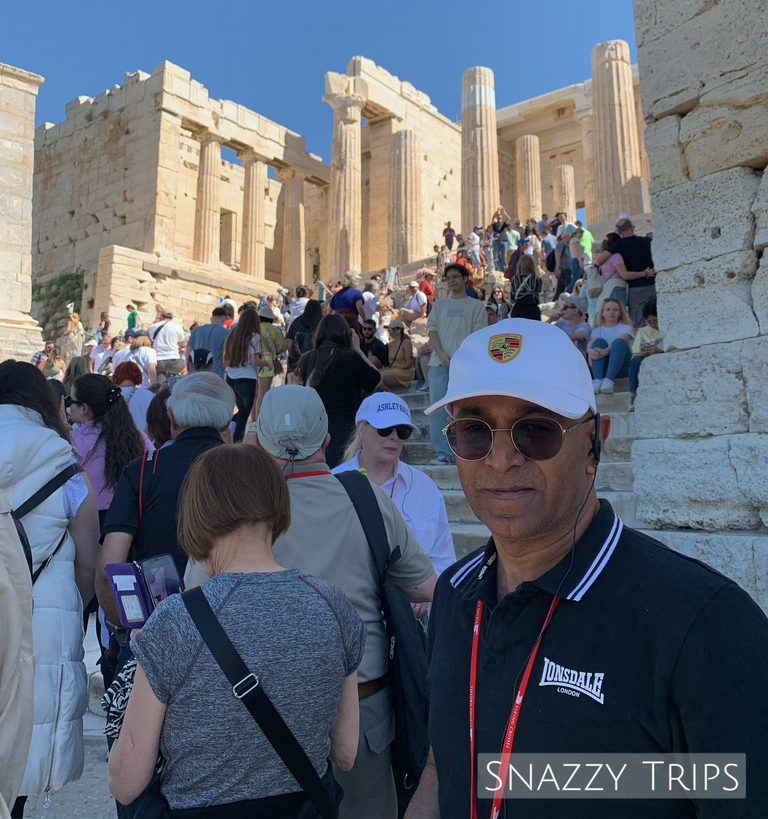
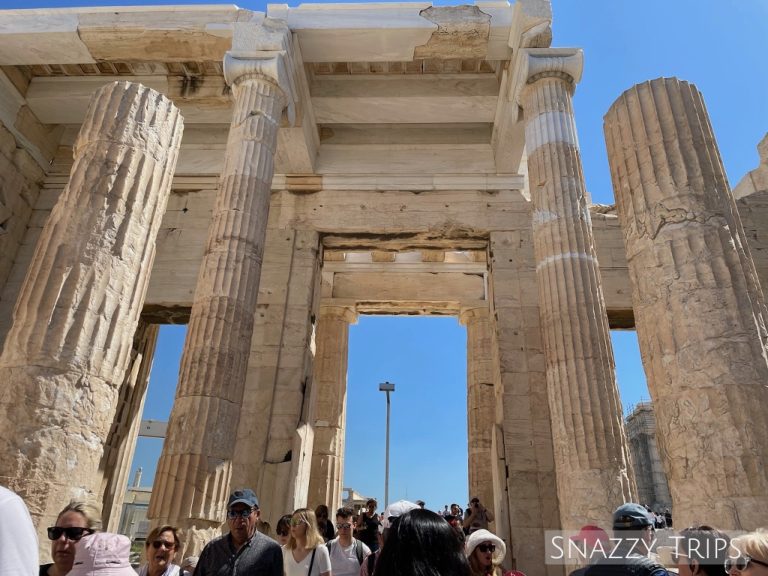
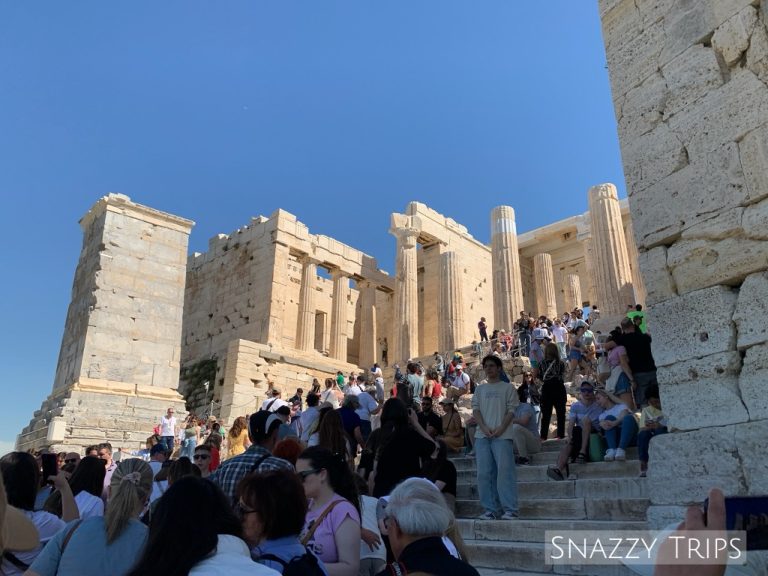
The impressive marble entrance of the Acropolis is called the Propylaea, a massive reception hall to greet visitors to this sacred place. The Greeks certainly know how to make a grand entrance, literally.
The experience of walking through this gateway is amazing and you feel like you have arrived at somewhere truly special, as you walk up the many steps to be greeted by the colossal marble structure. A central foyer leading you through the corridor of doric columns and on each side you see chambers with ionic columns. These wings would have been utilised for showcasing artwork and for receiving guests. Imagine the excitement being amongst such grandeur.
The inside would have been painted and decorated with motifs and reliefs of Gods and mythical beings and battles fought, paintings adorning the walls, statues and the coffered ceiling apparently was adorned with stars and painted blue.
The build of the Propylaea commenced after the Parthenon was finished in around 437 BCE, but it was never completed due to war at the time and a lack of funds.
Reconstruction works have been quite successful in bringing back some of its former glory.

Temple of Athena Nike
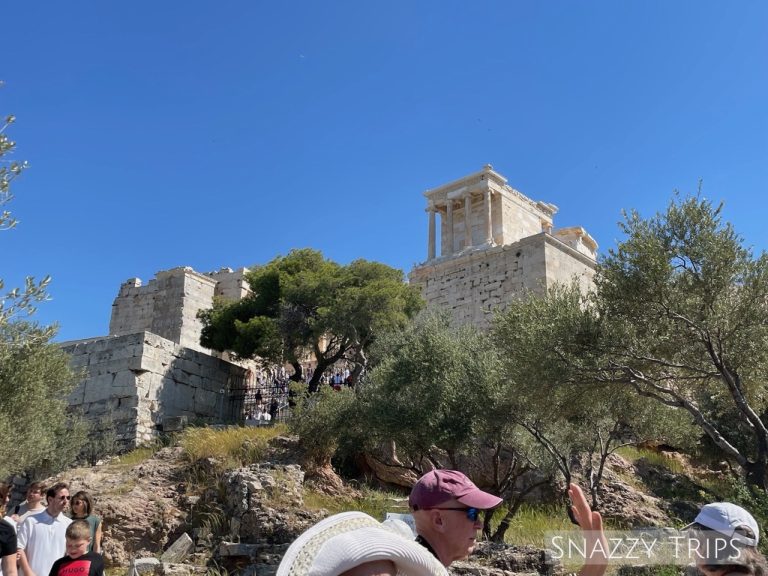
A small temple built in honour of the Goddess Athena and the Goddess Nike, sitting precariously on a steep corner of the Acropolis, to worship both deities as one, for victory in war. Made of marble in the Ionic style, it is quite a modest size, tiny for a temple, and somewhat overshadowed by its more prominent counterparts on the hill.
Completed in 420 BCE, it was much later dismantled then reassembled. Then dismantled again last century and reconstructed this century in better fashion.
The marble columns here are monolithic, one whole piece of stone, as opposed to columns made with blocks, as per the Parthenon.
Inside, there was a statue of Athena, either of marble or wood, historians aren’t sure which. It could be seen through the columns, and people would worship the Goddess from outside. No one was permitted inside, perhaps because it was so small, measuring only 3.8 x 4.2 metres.
It sits on a steep bastion on the corner of the hill, affording it fabulous views of the city, with rather severe drops on three sides, which seems somewhat dangerous for people paying their respects. Later, a barrier was built around it, but there isn’t one today.
However, this elegant petite structure is actually my favourite one of the Acropolis.
More photos of my Acropolis experience

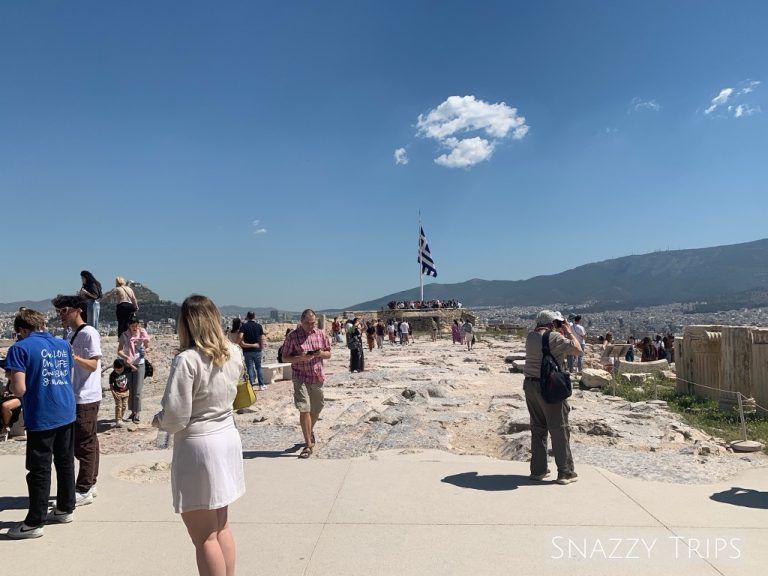


You may enjoy Visiting The Colosseum in Rome.
Other ancient sites seen from the Acropolis
Odeon of Herodes Atticus Theatre
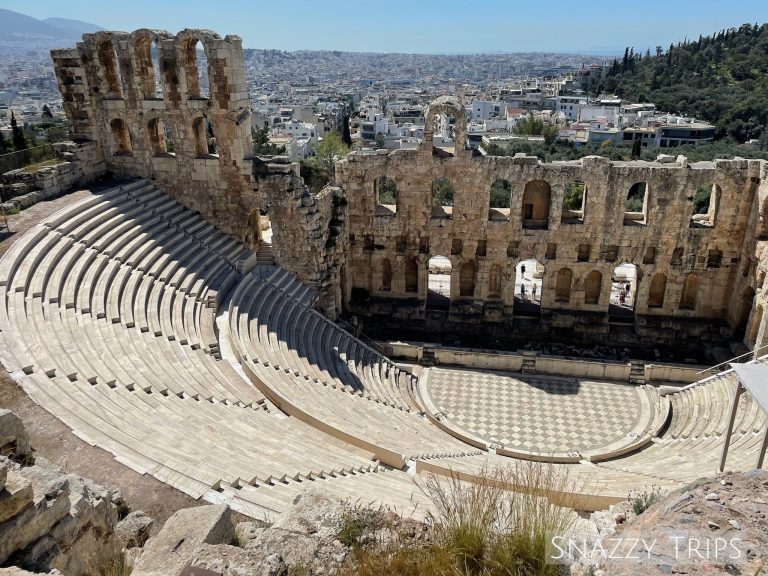
Below the Acropolis sits the ancient Roman theatre from 161 CE, the Odeon of Herodes Atticus, named after this great benefactor of Athens, who was a Greek philosopher, orator and a Roman senator. In modern times, it is known as Herodeon. The arena can seat more than 4,600 people for festivals, shows and performances.
This view can only be seen from the Acropolis. If you want to visit Herodeon you must purchase a ticket.
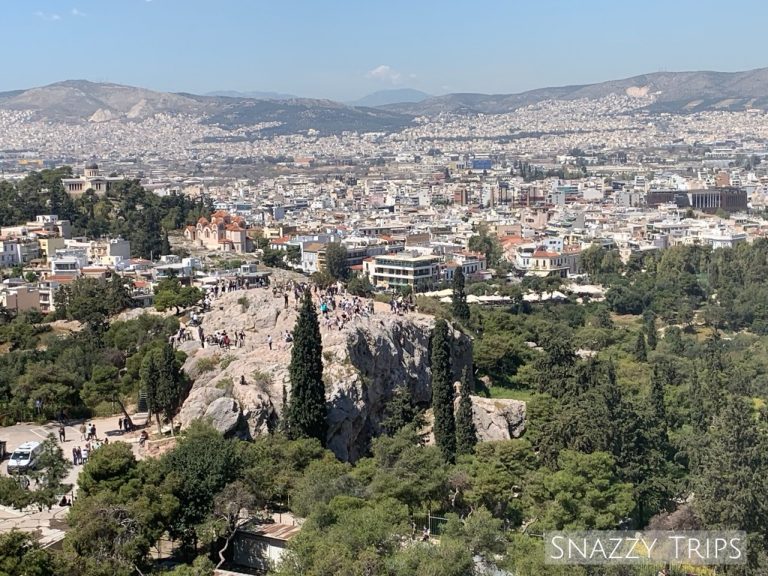
Areopagus Hill
The large mound of rock you see below was famous in Greek mythology. Trials were once heard here before the political Council of the Areopagus, a judicial body of aristocrats from the 7th century BCE. There doesn’t seem to be any evidence of the original building there, only proof of a later church, monastery and housing.
It is free to visit and explore and is a popular spot, as you can see from all the people there.
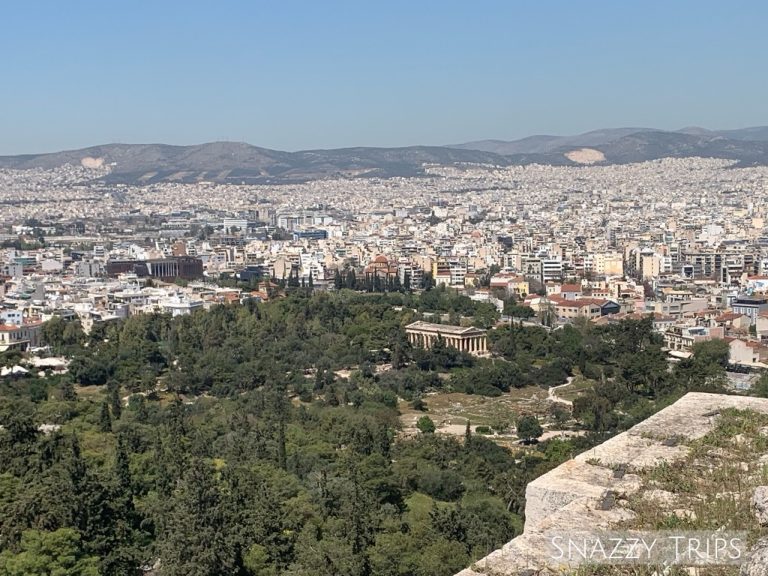
Temple of Hephaestus
Located in the ancient Agora of Athens, a meeting place of the ancient city, is the Temple of Hephaestus (Hephaisteion), also known as the Theseum Temple. Dating from the 5th century BCE, it is thought to be slightly older than the Parthenon, by a few years.
Originally constructed for worshipping the Gods of Artisans and Crafts, Hephaestus and Athena. Later it became a church, a burial place and then a museum, being used continuously throughout history. The monument has been very well maintained and almost completely in tact, with a complete roof.
You must purchase a ticket to visit this temple.
You may want to take a full day walking tour of Athens which includes the whole Acropolis experience and other ancient sites of the city.
Acropolis Fun Facts
- Greece has many other acropoleis, but the term acropolis refers to this particular site.
- The Acropolis covers an area of seven and a half acres.
- It is sometimes called the Sacred Rock.
- The Parthenon is one of the most copied buildings in the world.
- There is a full replica of the Parthenon in Tennessee, USA.
- The Temple of Athena has been destroyed and rebuilt 3 times.
- The Erechtheion porch of the maidens columns are replicas.
- Everything including the architecture, temples and statues, was originally colourfully painted.
- There are cave sanctuaries at the Acropolis, that were places for worshipping various deities, such as Zeus, Eros and Apollo.
- The Acropolis is a UNESCO World Heritage Site.
- It is illegal to wear high heels at the Acropolis.
- The whole Acropolis site has been under extensive renovation works since 1975 and is ongoing.
- Techniques and tools used for the restoration works are similar to those of the ancient craftspeople.
- The white marble replaced is quarried from the original source, Mount Penteli.
- It is illegal to fly planes and drones over the site.
- A rare plant with small pink flowers called the Micromeria Acropolitana grows only on the slopes of the Acropolis.
Information for your Acropolis Experience
Opening hours – During daylight only and seasonal hours apply.
Entry Cost – From 20 Euros per adult.
Crowds – Long queues to be expected, up to an hour.
Time – Allow at least 2 hours to tour the site.
Bags – No large items are permitted. Bag searches may be required.
Walking – There are approximately 250 steps to climb up the hill. Marble pathways can be slippery. Rocks are scattered around the ruins.
Shade – Virtually no shade at all.
Touching – Do not touch or step inside any of the temples or monuments.
Free days – There are several days throughout the year when entry is free for all.
Closed – Not open some public holidays.
Share on Pinterest
-
12 Best Prague Tours And Experiences
DAY TRIPS, FEASTS AND EXCURSIONS Prague is one of the most beautiful cities in Europe, with a gorgeous fairytale old town,... -
Fun Facts About Amsterdam
25 WEIRD AND WONDERFUL THINGS I'VE DISCOVERED A popular travel destination with UNESCO listed sites and a vibrant culture, the wonderful... -
Day Trip To Alkmaar From Amsterdam
IS IT WORTH SEEING? Yes, absolutely, a day trip to Alkmaar from Amsterdam is worth it, an ideal excursion, or to... -
Best Things To See In Wertheim Am Main
Visitors guide of the best things to see in Wertheim am Main, a charming medieval German town, with beautiful half-timbered... -
Classical Concert At Liechtenstein Garden Palace
AN EXQUISITE EVENING IN VIENNA During my 3 day visit to Vienna, the capital of Austria, I had the opportunity to...



16 Comments
MY son would love to visit Athens one day, it looks super busy so I would need to visit off season!
This is part of our bucket list and we’re actually looking forward to visiting early next year. Will take your word and consider getting the guided tour. Thank you for sharing your experience and these fun facts. I am bookmarking this post for future reference.
I would really like to visit Greece someday! These historical places always feel a little busy for me, but there is a lot to admire and learn about there.
This is such an informative post. I knew only about the main Acropolis structure but did not know that it is surrounded by so many other places to see. Its definitely on my list.
I loved visiting !!! Went back in 2017 and still am so impressed with the monuments in Greece !
All of this ancient architecture is so fascinating! I hope we get to see this in person one day.
We visited the Acropolis back in 2008 and were in awe. We have to go back, since at that time the old museum was closed down and the new museum was being build.
So happy that I visited Acropolis, awesome treasure of info here. Such a marvel to visit..
Hello! Do you recommend visiting Acropolis on my own or with an organized tour?
I recommend joining a tour to get the most out of your visit to the Acropolis.
I always visit ruins as I love the history and this is a fabulous review of the Acropolis. I felt like I was back there.
I live in Rome and I’d love to explore Greece’s Acropolis as well to connect the historical dots. I love the fun facts and information that you gave, well done!
I hope to visit Athens and Acropolis this year. Thank you for sharing all this information!
So exciting reading this – can’t wait to visit.
I loved Rome and and now I can’t wait to visit Greece.
Thanks so much! 🤩
Loved this! Such a great review of the Acropolis experience! i visited a couple of years ago and absolutely loved it but it was just too hot! Never ever go during summer!
I love Roman ruins. Greece is on my bucket list for sure!