ENRICH YOUR TRAVELS IN EUROPE THROUGH LANGUAGE
Are you thinking of learning a European language for your next vacation in Europe, to help you discover more about this marvellous continent and mingle with the locals? Or are you just interested in broadening your life skills? Or simply wanting to become a polyglot? The following interesting facts about European Languages may help you decide on a language to learn for your future travels and personal development.
Travel
Learning a language is a fabulous way to appreciate a country and understand its people and culture, as language and culture are very much intertwined. Connecting and interacting with the local people is the key to enriching your travels and getting the most out of the experience. The best way to do this is to learn a little of the local language.
Learning another language
The quickest way to learn another language is by immersing yourself in the local language when travelling around a country, asking directions, ordering food, buying goods and so forth. Forcing yourself to communicate along the way is hard at first but becomes easier each day, with practice and a little determination. You will find it very rewarding. Locals appreciate and respond kindly to your efforts and are more likely to help you. People are usually quite impressed to hear tourists conversing in their native tongue.
Personal development
Knowing a second language is a personal asset, can help with your career aspirations, broaden your horizons, and improves your cognitive skills. It has been shown to assist with memory, concentration and multi-tasking among other things.
Europe
Europe has a diverse and rich multi-cultural landscape due to the geography, history and migrations across the continent. Because of this Europeans have evolved as naturally bilingual and even trilingual in their need to converse with others in nearby communities.
Europe has some of the most popular languages in the world, such as English, French, Spanish, Portuguese, Italian and German.
Learning a language
Choosing which language to learn can be a hard decision. But it depends where you intend to visit, study or work, which country you would like to learn more about, what culture interests you, what your own background is, and so on. I’ve studied 3 additional languages, Italian, Spanish and French. One is of my heritage and the others for my own personal satisfaction. I have found it very advantageous when travelling in Europe, being able to read signs, menus, asking for help, etc. and of course making some wonderful new friends.
So, let’s dive into these amazing facts about European languages to give you some food for thought.
Things you may not know about the many languages of Europe
There are currently over 200 languages spoken throughout Europe, including many regional dialects and indigenous languages.
Europe has 50 independent nations and states, as of 2021, but the European Union (EU) has only 27 member states and it uses 24 main languages, for official business. These are,
- Bulgarian
- Croatian
- Czech
- Danish
- Dutch
- English
- Estonian
- Finnish
- French
- German
- Greek
- Hungarian
- Irish
- Italian
- Latvian
- Lithuanian
- Maltese
- Polish
- Portuguese
- Romanian
- Slovak
- Slovenian
- Spanish, and
- Swedish.
Most languages of Europe have evolved from the largest language family in the world – the Indo-European language family, which descended from the prehistoric language, Proto-Indo-European, originally spoken somewhere in Eurasia thousands of years ago.
The Indo-European language family has four main living branches in the world today – Balto-Slavic, Germanic, Italic, and Indo-Iranian which is outside Europe.
This language family evolved into the many European languages we know today.
Of the European population, which is approximately 750 million people, about 95% speak an Indo-European language as their native tongue.
Today’s European languages are broken down into the following language branches of the Indo-European family tree:
- Albanian
- Armenian
- Baltic Languages (Latvian and Lithuanian)
- Celtic Languages (Irish Gaelic, Scottish Gaelic, Welsh and Breton)
- Germanic Languages (Danish, Dutch, English, Frisian, German, all Scandinavian languages, and Yiddish)
- Greek
- Italic Languages (Latin and all Romance languages) and
- Slavic Languages (Bulgarian, Czech, Croatian, Macedonian, Polish, Russian, Serbian, Slovak and more).
Other languages of Europe not part of the Indo-European family can be grouped as follows:
a. The Uralic language family of Europe, descended from northern Eurasia, which include,
- Estonian
- Finnish, and
- Hungarian.
b. The Turkic language family of Europe, also from Eurasia, include,
- Turkish
- Azerbaijani
- Kazakh, and
- Tatar.
c. The Basque language is in a group all of its own.
d. Two North Caucasian languages spoken in the North Caucasus, part of Eastern Europe.
e. Maltese, a minor Semitic language based on Arabic, spoken in Malta.
And
f. Cypriot Arabic, spoken by a small minority in Cyprus.
Basque is believed to be the oldest language of Europe still spoken today in parts of France and Spain, although there is little known of its history, but appears to have originated prior to the arrival of Indo-European languages.
The Romance languages descended from the Roman Empire, which used a vernacular language form of Latin called Vulgar Latin. The Romance languages are easily identified as:
- Italian
- French
- Spanish
- Portuguese
- Romanian
- Catalan
- Occitan
- Sardinian, and
- Corsican.
The most spoken language in Europe is Russian, with 150 million native speakers. However, Russian is surprisingly, not an official language of the European Union.
The most widely used language throughout all of Europe is English. As well as being the native tongue of the United Kingdom and Ireland, more than half Europeans speak English as a second language. It has become the unofficial second language of Europe. Hence, when travelling Europe you can get by speaking English in many places.
English is a Germanic language, part of the Indo-European family tree. However, 58% of the vocabulary comes from the Romance languages of Latin and Greek.
In the EU, the German language has the largest number of native speakers, 100 million people.
The least spoken language of the EU is Romanian with 23 million native speakers. Romanian is sometimes referred to as the forgotten Romance language.
Italian is considered by many to be the closest to Latin, descended from Vulgar Latin used by the Roman Empire. Sardinian is also close to Vulgar Latin.
Most European languages use the Latin alphabet. Others use the Cyrillic alphabet and the Greek alphabet.
Many European languages have become extinct, meaning there are no living speakers. Some of the extinct languages of Europe are:
- Anatolian
- Gothic
- Dalmatian, and
- many Russian languages.
A whole host of other European languages and dialects are seriously endangered due to the fact that young people aren’t speaking them, and there are few surviving speakers left. These are just some of the most at risk of extinction:
- Faroese, of the Faroe Islands
- Karaim, of Ukraine, Lithuania and Poland
- Manx, of the Isle of Man
- Pite Sami, of Sweden and Norway
- Cappadocian Greek, of Greece
- Tsakonian, of Greece
- Wymysorys, of Poland
- Welsh, of Wales, and
- Cornish, of the UK.
Most Europeans can speak more than one European language. More than half of the population in fact.
Amazingly, 10% of Europeans are quadri-lingual, meaning they can speak 4 languages.
The easiest European languages to learn are usually those from the same language family as your native tongue. Hence, native English speakers will find it easier to pick up Dutch or German, as they are both from the Germanic family and thus have similar vocabulary and grammatical structure to English.
Of the Romance language family, Italian is the easiest to learn for most English speakers, because it is written and pronounced as spelled.
The most difficult European languages to learn for native English speakers are Hungarian, Finnish, Basque and Icelandic.
The notion of having one common language for mainstream communication throughout Europe has been considered. Latin, Esperanto or Interlingua are options that have been put forth. But the EU has rejected the idea of using one language, stating that it goes against their principles of diversity and multilingualism.
Esperanto is a created language from the 1800’s which is a combination of several Indo-European languages and is easy to learn.
Interlingua is another invented language from the 1900’s based on Romance languages and is also easy to pick up.
Both were developed to facilitate communication internationally, as a universal second language. Esperanto is more widely used.
On 26 September each year Europe celebrates European Day of Languages. Since 2001, countries hold events and activities to commemorate linguistic heritage and promote diversity of European languages into the future.
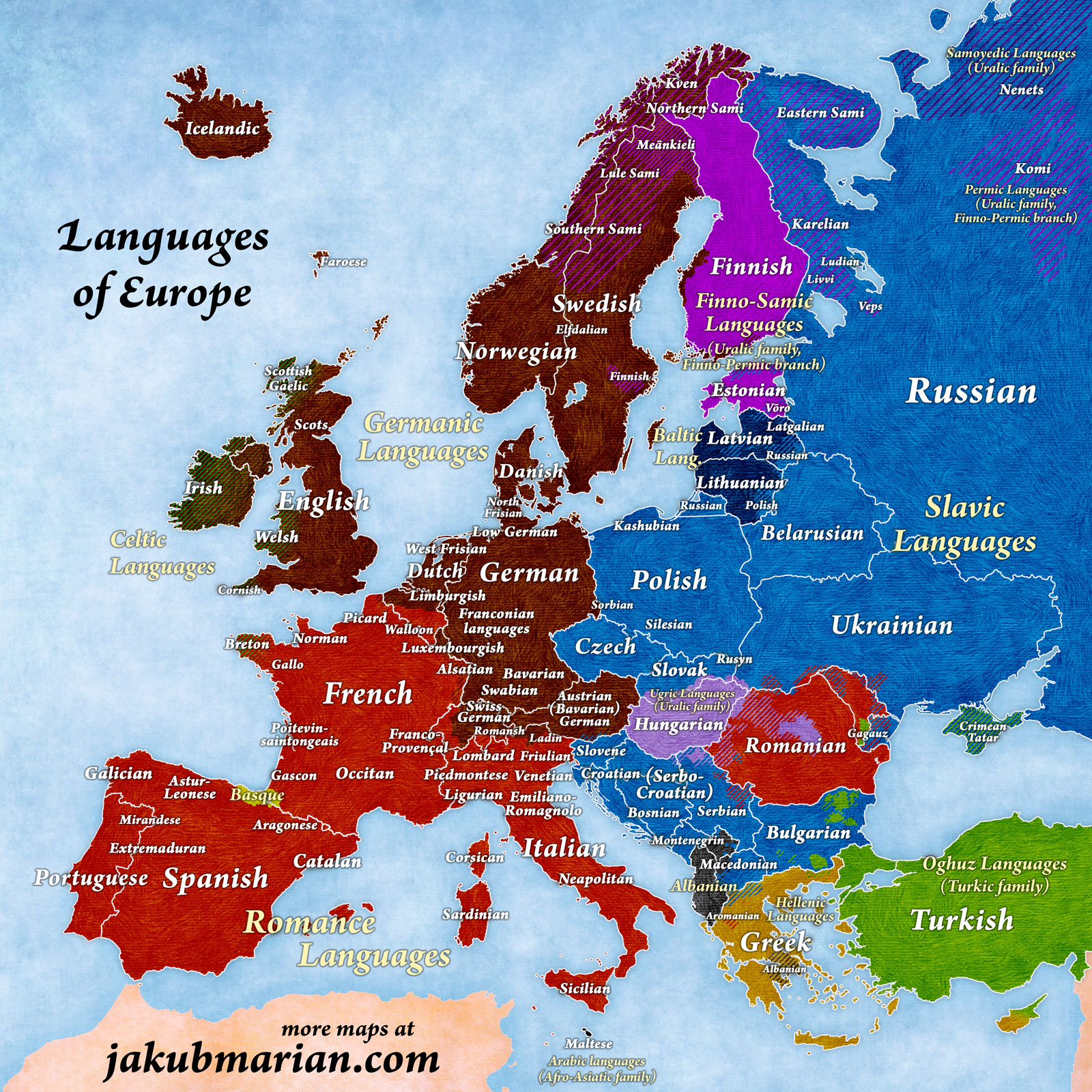
Map of Languages of Europe
The map below illustrates the languages of Europe in detail, with varieties of the main local language spoken.
European Languages – map credit
Tours in Europe
Pin it!
Other Snazzy posts
-
35 Important Travel Tips For Istanbul
These 35 important travel tips for Istanbul will help you navigate your time in Turkey's capital city. Helpful advice and... -
Experience The Bizarre Mona Museum In Hobart
If you are going to Tasmania, you must experience the Mona Museum in the capital city of Hobart. What is... -
The Picturesque Town Of Rüdesheim am Rhein
A popular cruise stop on the Rhine River, in the Rhine Gorge, is the picturesque town of Rüdesheim am Rhein,... -
A 15 Day Scenic River Cruise In Europe
AMSTERDAM TO BUDAPEST, PLUS PRAGUE I recently embarked on an all-inclusive luxury river cruise with Scenic River Cruises, and had a... -
Essential Guide To Montserrat Monastery Spain
HOW TO GET THERE, THINGS TO SEE AND DO In an epic mountain range located in the autonomous region of Catalonia... -
Unbelievable Louvre Pyramid Facts You Didn’t Know
A SPARKLING JEWEL OF PARIS The Grand Louvre Pyramid is a stunning piece of architecture and the crowning jewel of the... -
Essential Tips For Visiting Malaysia
A GUIDE FOR FIRST-TIMERS Visiting a new country can be a bit daunting, so if you're thinking of visiting Malaysia, here... -
India’s Most Beautiful Temple
Klook.com AKSHARDHAM TEMPLE Located in New Delhi, on the banks of the Yamuna River, is Swaminarayan Akshardham Temple, India's most beautiful Temple.... -
London Landmarks On The River Thames
6 PLACES YOU SHOULD VISIT Going to London, UK for a short stay? Here are 6 popular London landmarks you should... -
12 Really Cool Facts About Malaysia
THINGS TO INSPIRE YOU TO VISIT When visiting other countries, I love learning fun and interesting facts to allow me to...


15 Comments
Wow! I didn’t know Europe has more than 200 languages! I am pretty familiar with Spanish and I love it! Planning to get familiar with French too as they sound very nice.
I had no clue that Europe has so many languages. I love Spanish, French and Italian language. Would love to learn few of these languages.
Thanks for listing out these awesome facts about European languages. Learned a lot!
These are some really interesting facts. I was quite surprised about Romania being the least spoken in the EU, I didn’t expect that!
I had a friend in college who was from Romania and the language when spoken in so beautiful. I remember her telling me all about the country and showing me these jaw-dropping pictures of places in Romania.
Learning a language is so much easier when you actually can speak that language! So much to lean here.
I didn’t realise there were as many as 200 different languages spoken across Europe alone. I am fluent in 1 and can get by in another and know a few odd bits from a few other languages to manage if needed. I do try to speak in other languages when in the country.
I speak two languages and three dialects of my home country. It would be great to learn another language like French maybe.
The diversity of European languages is so intriguing. This article sheds light on details I’d never considered before, like how languages influence culture and communication across countries.
This article is such an eye-opener. I never knew there were so many unique European language facts, especially about their roots and similarities.
Oh, wow. I can’t imagine being able to speak four languages! I do my best to keep up with two.
The sheer amount of languages is what’s so amazing to me. I mean, the countries are so small. It’s amazing that so many languages developed.
I didn’t know much about these facts and I’m European! I speak English, Spanish and Italian and so need one more to be quadrilingual (not sure if that’s right!)
I am terrible for learning a new language, but I do try to learn some of the language before travelling anywhere as it shows I am at least trying
I love learning new languages, and the European languages are some of my favourite to have learned throughout my life. It’s so fun to be able to speak to people across the continent!